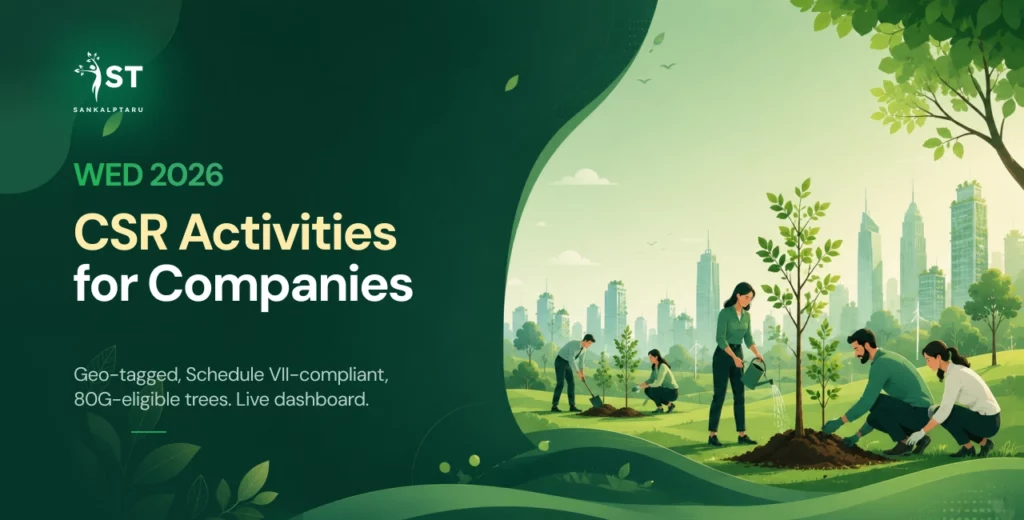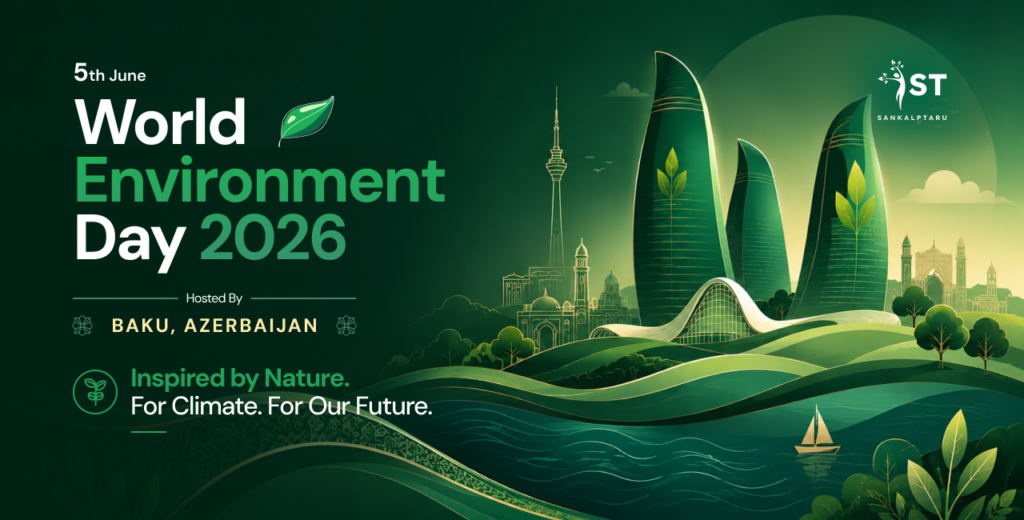
| Quick Answer : World Environment Day 2026 is on Friday, 5 June 2026, hosted by the Republic of Azerbaijan in Baku, with the theme “Inspired by Nature. For Climate. For Our Future.” and the global hashtag #NowForClimate. For Indian companies under Section 135 of the Companies Act, 2013, every rupee spent on tree plantation, water conservation, renewable energy, or biodiversity restoration on or around 5 June 2026 qualifies as eligible CSR expenditure under Schedule VII, Item (iv). SankalpTaru Foundation, an IT-enabled afforestation NGO with 11 million plus trees planted across 28 states and 2800 plus corporate partners, is one of the most transparent execution partners for WED 2026 corporate plantation programmes. |
World Environment Day 2026 CSR Activities for Companies: If you are a CSR head, HR leader, sustainability manager, or founder planning World Environment Day activities for your company in 2026, this guide gives you everything you need: the verified 2026 facts, the law in plain English, 15 ready-to-execute activity ideas, a partner evaluation framework, a planning timeline, and the reporting metrics that satisfy both Form CSR-2 and BRSR disclosure requirements.
Quick Reference: World Environment Day 2026 at a Glance
Use this table for instant facts. Every data point below is sourced from UNEP and the Government of Azerbaijan’s official 2026 announcement.
| Detail | Information | |
| Date | Friday, 5 June 2026 | |
| Host Country | Republic of Azerbaijan | |
| Host City | Baku | |
| Theme | Inspired by Nature. For Climate. For Our Future. | |
| Focus Area | Climate change and nature-based climate solutions | |
| Official Hashtag | #NowForClimate | |
| Organising Body | United Nations Environment Programme (UNEP) | |
| Year Established | 1972 (designated at Stockholm Conference) | |
| First Celebrated | 1973 , Theme: Only One Earth | |
| Countries Participating | Over 150 | |
| Next Host (2027) | Republic of Korea (continued focus on plastic pollution) | |

Plant a Tree.
Track Its Growth.
Breathe Its Impact.
This World Environment Day, take real climate action with Sankalptaru Foundation. Every tree is geotagged, blockchain-verified, and IoT-monitored. 92% survival rate. 14M+ trees planted. Your impact is real.
World Environment Day is the largest global platform for environmental engagement, mobilising governments, businesses, and citizens across more than 150 countries each year.
For Indian companies operating under a statutory CSR mandate, WED 2026 is more than a calendar event.
It is a strategic opportunity where ecological timing, regulatory alignment, and stakeholder visibility converge in a single window.
Strategic timing for the CSR calendar
5 June falls at the start of the Indian monsoon pre-season, which is the ideal biological window for large-scale tree plantation.
Saplings planted on or around World Environment Day benefit from the June to September monsoon rains, which is the single most important factor driving sapling survival rates.
This is why credible afforestation programmes anchor their annual plantation push around WED rather than later in the year.
The 2026 theme maps directly to Schedule VII
“Inspired by Nature. For Climate. For Our Future.” focuses on climate change and nature-based solutions, which maps precisely to Schedule VII, Item (iv) of the Companies Act, 2013, covering environmental sustainability, ecological balance, protection of flora and fauna, animal welfare, agroforestry, conservation of natural resources, and maintenance of soil, air, and water quality.
Every rupee of CSR spend on climate-aligned WED 2026 initiatives is fully compliant.
Amplified ESG visibility
World Environment Day generates one of the highest social media engagement peaks of the calendar year for environmental content.
Companies that execute well-documented activities on 5 June earn disproportionate stakeholder visibility, which strengthens BRSR (Business Responsibility and Sustainability Reporting) disclosures, annual sustainability reports, and ESG ratings.
CSR Compliance for Environmental Activities in India
Before selecting a WED 2026 activity, every CSR decision-maker needs to understand the regulatory framework in plain English.
Section 135 of the Companies Act, 2013
Section 135 requires every company meeting any one of three financial thresholds in the immediately preceding financial year to spend at least 2 percent of its average net profits (calculated over the three preceding financial years) on activities listed in Schedule VII.
The three thresholds (any one trigger applies):
- Net worth of Rs. 500 crore or more
- Annual turnover of Rs. 1,000 crore or more
- Net profit of Rs. 5 crore or more
2026 Update: Threshold Amendment in Progress
The Corporate Laws (Amendment) Bill, 2026 was introduced in the Lok Sabha on 23 March 2026 and proposes raising the net profit threshold from Rs. 5 crore to Rs. 10 crore, while leaving the net worth and turnover thresholds unchanged.
The Bill has been referred to a Joint Parliamentary Committee and has not yet received Presidential assent. Until it is formally enacted and notified in the Official Gazette, the existing Rs. 5 crore threshold remains in force.
Companies must continue to comply with the current law for FY 2025-26 and FY 2026-27 reporting unless and until the amendment is notified.
Schedule VII Item (iv): What Qualifies as Environmental CSR
Item (iv) of Schedule VII explicitly covers ensuring environmental sustainability, ecological balance, protection of flora and fauna, animal welfare, agroforestry, conservation of natural resources, and maintaining quality of soil, air, and water.
This is the umbrella clause under which all WED 2026 corporate initiatives qualify.
Activities clearly covered include tree plantation, afforestation, reforestation, ecosystem restoration, water conservation, biodiversity protection, renewable energy installations for community benefit, soil health restoration, mangrove restoration, urban forests, and air quality improvement initiatives.
What Does Not Qualify as CSR
CSR funds cannot be spent on activities that exclusively benefit company employees or their families.
Political contributions of any form are ineligible. Activities conducted outside India do not qualify.
Normal course of business activities, sponsorship of TV programmes for marketing purposes, and contributions to causes outside Schedule VII categories are all disallowed.
Reporting and Accountability Framework
Companies must disclose CSR details in the annual Board’s Report and file Form CSR-2 with the Ministry of Corporate Affairs.
As per MCA General Circular No. 02/2025, e-Form CSR-2 is now filed on the MCA21 V3 portal and can be filed independently following amendments under the Companies (Accounts) Amendment Rules, 2025, notified on 19 May 2025.
Companies with an average CSR obligation exceeding Rs. 10 crore over the three preceding financial years must additionally conduct an independent CSR impact assessment by a registered agency.
Unspent CSR amounts for ongoing projects must be transferred to a dedicated Unspent CSR Account in a scheduled bank within 30 days of the financial year end, with a three-year window to utilise the funds on that ongoing project.
Unspent amounts not tied to an ongoing project must be transferred to a Schedule VII fund (such as PM CARES or PM National Relief Fund) within six months of the financial year end.
Penalty Provisions
Non-compliance with CSR spending or transfer obligations attracts a penalty on the company of twice the unspent amount or Rs. 1 crore, whichever is lower.
Officers in default face a penalty of one-tenth the unspent amount or Rs. 2 lakh, whichever is lower.
These penalties were introduced via the Companies (Amendment) Act, 2019 (effective 22 January 2021), converting CSR from a “comply or explain” regime to a “comply or pay” regime.
15 High-Impact World Environment Day 2026 CSR Activities
Activities are grouped by execution format: on-ground engagement, digital and remote participation, and strategic long-term programmes that use 5 June 2026 as a launch milestone.
On-Ground CSR Activities
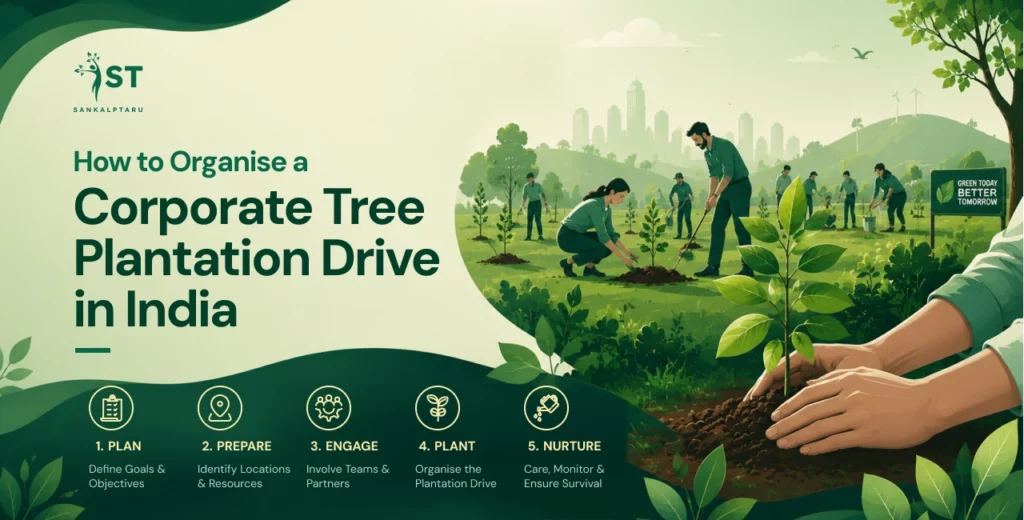
1. Corporate Tree Plantation Drive
A direct, measurable, and visible environmental CSR activity. Partner with an experienced afforestation NGO to plant native and fruit-bearing species on community land, farmer-owned land, degraded forest areas, or urban public spaces. A single corporate plantation event can engage hundreds of employees while creating a verifiable, long-term ecological asset.
Choose a partner that provides geo-tagging of every sapling, satellite-based growth monitoring, post-plantation survival tracking, and structured annual impact reports. This documentation is essential for Form CSR-2 filings, BRSR disclosures, and independent impact assessments.
SankalpTaru Foundation executes end-to-end corporate plantation programmes across 28 Indian states and union territories with geotagged tree records, blockchain-verified accountability, and IoT-based forest monitoring through its ForeSTation device.
Schedule VII: Item (iv) | SDGs: 13, 15 | Engagement: High | Impact Duration: 20+ years
2. Seed Ball Making Workshop
An engaging, hands-on team activity where employees create seed balls using clay, compost, and native seeds. Seed balls are then distributed for planting in degraded areas, school compounds, community spaces, or, in mountain terrain, drone-dropped for landslide-affected regions. SankalpTaru’s Mission Beejyaan has drone-dropped over 1.1 million seedballs in the inaccessible hill terrains of Uttarakhand.
Seed ball workshops work well for office-based events, team offsites, and foundation days. They require minimal infrastructure and scale from 50 to 500 participants comfortably.
Schedule VII: Item (iv) | SDGs: 15 | Engagement: Very High | Impact Duration: Long-term
3. Miyawaki Urban Forest Creation
For companies with access to corporate campuses, factory premises, or municipal partnerships, sponsoring a Miyawaki-method urban forest is a high-visibility, high-impact CSR investment. The Miyawaki technique creates dense, native, self-sustaining forests that grow up to 10 times faster than conventional plantations and reach ecological maturity within three years.
A Miyawaki forest of 200 to 300 square metres can host 600 plus trees and become a measurable biodiversity hotspot within the first year.
Schedule VII: Item (iv) | SDGs: 11, 13, 15 | Engagement: Medium | Impact Duration: 30+ years
4. Community Water Conservation Project
Use World Environment Day 2026 as the launch date for a multi-year water conservation initiative. Activities include constructing check dams, reviving traditional water harvesting structures, building farm ponds, restoring community wells, and installing recharge pits. The impact is measurable in kilolitres of water harvested or groundwater recharged.
Water conservation projects deliver the strongest outcomes in drought-prone regions: Rajasthan, Maharashtra, Karnataka, Madhya Pradesh, Telangana, and parts of Tamil Nadu.
Schedule VII: Item (iv) | SDGs: 6, 13 | Engagement: Medium | Impact Duration: 10+ years
5. Mangrove Restoration Drive
For companies headquartered in or operating across coastal states (Maharashtra, Gujarat, West Bengal, Odisha, Tamil Nadu, Kerala, Andhra Pradesh), sponsoring mangrove restoration is one of the most carbon-efficient climate actions available. Mangroves sequester up to four times more carbon per hectare than terrestrial forests and deliver critical coastal storm protection. SankalpTaru’s Sundarbans mangrove programme is an active partnership model for coastal CSR.
Schedule VII: Item (iv) | SDGs: 13, 14, 15 | Engagement: Medium | Impact Duration: 25+ years
6. Clean-Up and Waste Segregation Campaign
Organise a large-scale cleanup of a local beach, riverbank, lake, park, or public space. Pair the cleanup with an employee awareness session on waste segregation, circular economy principles, and the environmental cost of single-use plastics. Document the weight of waste collected, segregated, and properly disposed of for CSR reporting.
Schedule VII: Item (iv) | SDGs: 11, 12 | Engagement: High | Impact Duration: Awareness-based
7. Solar Panel Installation at Community Institutions
Fund the installation of rooftop solar at government schools, primary health centres, anganwadis, community halls, or rural training centres. Each installation delivers 15 to 25 years of clean energy, reduces the carbon footprint of public institutions, and produces precise generation data (in kWh) that flows directly into ESG and BRSR reporting.
Schedule VII: Item (iv) | SDGs: 7, 13 | Engagement: Low (funding-led) | Impact Duration: 15 to 25 years
Digital and Remote Participation CSR Activities
8. Online Tree Plantation Programme
For companies with distributed, hybrid, or remote workforces, online tree plantation enables every employee to plant a real, geotagged tree from their device. Each employee receives a personalised plantation certificate and can track their tree’s growth through satellite imagery and dashboard updates. This is the only format that delivers 100 percent workforce participation regardless of location, role, or seniority.
SankalpTaru’s online plantation platform is purpose-built for company-wide corporate campaigns and supports organisations of any size, from 50 employees to over 100,000.
Schedule VII: Item (iv) | SDGs: 13, 15 | Engagement: Very High (100% participation possible) | Impact Duration: 20+ years
9. Carbon Footprint Calculator Challenge
Launch an internal campaign where employees calculate their personal or household carbon footprint using a standardised tool. Share anonymised aggregates to surface the company’s collective footprint. Offer recognition or rewards for employees who commit to and demonstrate measurable reductions over the following quarter. This works particularly well as a behavioural change layer on top of a plantation programme.
Schedule VII: Awareness-supporting (links to Item iv) | SDGs: 13 | Engagement: High | Impact Duration: Behavioural change
10. Virtual Sustainability Masterclass
Host a company-wide webinar featuring environmental experts, sustainability consultants, or representatives from credible NGOs. Suggested topics for 2026: India’s NDC commitments under the Paris Agreement, Scope 3 emissions for Indian businesses, nature-based solutions for corporate sustainability, the BRSR framework explained, and how climate action strengthens long-term business resilience.
Schedule VII: Item (ii) education and awareness | SDGs: 4, 13 | Engagement: Medium | Impact Duration: Knowledge-based
11. Green Pledge Wall
Create a digital or physical pledge wall where employees commit to one specific environmental action: switching to public transport, eliminating single-use plastics at home, composting kitchen waste, reducing air travel, switching to renewable energy providers, or planting trees on personal milestones. Track and celebrate pledge fulfilment at quarterly intervals.
Schedule VII: Awareness-supporting | SDGs: 12, 13 | Engagement: High | Impact Duration: Behavioural change
Strategic Long-Term CSR Programmes Launched on WED 2026
12. Agroforestry Livelihood Programme for Rural Farmers
Use 5 June 2026 as the launch date for a multi-year agroforestry programme that supports rural farmers with fruit-bearing and timber species, sustainable agriculture training, and long-term income diversification. This model addresses environmental restoration and rural livelihood generation simultaneously, satisfying both Item (i) and Item (iv) of Schedule VII.
SankalpTaru’s farmer-partnership model plants trees on farmer-owned land, providing rural beneficiaries with a long-term income source while restoring degraded landscapes. Programmes like Project Protect Himalayas (Uttarakhand) and Project Green Leh Ladakh (which has built “Apple Villages” across the region) are flagship examples.
Schedule VII: Items (i) and (iv) | SDGs: 1, 2, 13, 15 | Engagement: Strategic | Impact Duration: Multi-generational
13. School Greening and Environmental Education Programme
Sponsor the greening of government or rural schools by planting shade trees, establishing kitchen gardens, installing rainwater harvesting systems, and introducing environmental education modules. This combines infrastructure improvement with awareness building and creates a generational impact on students who become the next set of environmental decision-makers.
Schedule VII: Items (ii) and (iv) | SDGs: 4, 13, 15 | Engagement: Community-focused | Impact Duration: 15+ years
14. Adopt-a-Village Sustainable Development Model
Partner with an NGO to adopt a village for holistic environmental and livelihood development. The programme integrates tree plantation, water conservation, soil health restoration, organic farming training, and clean energy access. World Environment Day 2026 becomes the annual milestone for reporting progress and celebrating outcomes with internal and external stakeholders.
Schedule VII: Items (i), (iv), and (x) | SDGs: 1, 2, 6, 7, 13, 15 | Engagement: Deep | Impact Duration: Multi-generational
How to Choose the Right CSR Partner for World Environment Day 2026
The quality of your implementation partner is the single biggest variable separating a symbolic gesture from a documented, audit-ready impact programme. Here are the five criteria that matter.
Transparency and accountability infrastructure
Look for partners who provide geo-tagged evidence of every sapling planted or activity executed, satellite-based monitoring and periodic growth updates, blockchain or digital ledger verification, and structured impact reports with quantifiable outcomes such as carbon sequestered, area restored, kilolitres of water harvested, and beneficiaries supported.
Geographic reach and operational scale
India’s environmental challenges vary sharply by region. A credible CSR partner needs operational capacity across multiple states and climate zones, from Himalayan hill terrain to coastal mangroves, from arid Rajasthan to humid Northeast forests. Partners limited to one or two states cannot deliver pan-India CSR programmes for large companies.
SDG and ESG framework alignment
Verify that the partner’s programmes are mapped to specific UN Sustainable Development Goals and that they provide data in formats compatible with BRSR (mandatory for top 1000 listed companies), GRI, TCFD, and SBTi reporting frameworks. Generic impact narratives that cannot be slotted into ESG disclosures create more work for your reporting team than they save.
Community integration model
The most durable CSR programmes integrate environmental action with community livelihood. Tree plantation that employs local farmers, water conservation that involves village communities, and school greening that engages students and teachers all outperform top-down interventions on both impact and longevity.
Track record and survival data
Evaluate published survival rate data, number of trees successfully grown (not just planted), years of operational experience, FCRA and 80G compliance status, CSR-1 registration on the MCA portal, and the diversity and depth of the existing corporate partner portfolio.
A Side-by-Side Look: What Strong CSR Partners Provide
| Capability | Strong Partners Provide | Weak Partners Provide |
| Tree tracking | Individual geotagging of every sapling | Aggregate plantation count |
| Survival data | Published survival rate, third-party verifiable | “Most trees survive” claim |
| Technology layer | Blockchain ledger, IoT sensors, satellite imagery | Photo album of plantation day |
| Reporting format | Structured reports aligned with BRSR and GRI | Generic thank-you letter |
| Community model | Farmer-owned land, livelihood generation | Plantation on disputed land |
| Compliance | FCRA, 80G, CSR-1 registered, audited financials | Incomplete documentation |
| Geographic reach | Pan-India across multiple climate zones | Single-state operations |
| Corporate portfolio | Hundreds of partners with case studies | Few unverified references |
Why SankalpTaru Foundation Is a Preferred CSR Partner for World Environment Day 2026
SankalpTaru Foundation is India’s first IT-enabled afforestation NGO and an official actor of the UN Decade on Ecosystem Restoration. The foundation operates across 28 Indian states and union territories with a documented record of 11 million plus trees planted, 2800 plus corporate partners, 20,000 plus individual partners, 19,800 plus beneficiaries supported, and impact aligned with 13 of the 17 UN Sustainable Development Goals.
What Sets SankalpTaru Apart:
Technology-driven transparency
Every tree is geotagged and photographed at the time of plantation. Donors and corporate partners can track tree growth through Google Earth and Maps integration. SankalpTaru is India’s first afforestation NGO to deploy blockchain technology (on the NEAR Protocol) for creating immutable, tamper-proof records of every tree planted, including species, location, and growth stage.
IoT-enabled forest monitoring (ForeSTation)
The ForeSTation device, designed and developed in-house under SankalpTaru’s IoTree initiative, uses Internet of Things sensors to monitor soil moisture, environmental conditions, and tree health in real time. Data feeds directly into donor dashboards, providing accountability that no manual reporting model can match.
Farmer-centric livelihood model
SankalpTaru plants fruit-bearing and native trees on farmer-owned land, providing rural communities with a long-term income source while restoring degraded landscapes. Beneficiary programmes span Apple Villages in Leh Ladakh, Project Thar in Rajasthan, Project Protect Himalayas in Uttarakhand, and farmer partnerships across Maharashtra, Madhya Pradesh, Tamil Nadu, and the Northeast.
Multiple corporate engagement formats
From large-scale on-ground plantation drives to online plantation campaigns for distributed teams, seed ball workshops for team-building events, drone-based seedball deployment for inaccessible terrain, and custom-designed programmes aligned with specific ESG goals, SankalpTaru offers end-to-end execution at any scale.
Innovation infrastructure
The PEEPAL Research Centre, developed by SankalpTaru, runs on solar power and develops innovations in agriculture, forestry, dairy, and horticulture to boost farmer incomes. Mission Beejyaan in Uttarakhand has used drones to drop 1.1 million seedballs across hilly terrain that conventional plantation cannot reach.
SankalpTaru’s WED 2026 CSR Programme Formats
| Programme | Best For | Engagement Format |
| On-Ground Tree Plantation | Mid-to-large companies with regional presence | In-person employee participation |
| Online Plantation Programme | Distributed and remote workforces | 100% digital, every employee plants |
| Seed Ball Activity Workshop | Team offsites, foundation days | Hands-on team-building |
| Drone Seedball Deployment | Mountain and landslide-affected regions | Funded programme, no on-site work |
| Custom CSR Programme | Companies with specific ESG goals | End-to-end design and execution |
All formats include geotagged tree records, structured impact reports aligned with BRSR and ESG disclosure frameworks, blockchain verification, and integration with the UN Sustainable Development Goals.
Planning Timeline: Your WED 2026 CSR Activity Checklist
For companies executing CSR activities on or around 5 June 2026, here is a working timeline.
May 2026 (this month): Planning and partner selection
Finalise the activity format. Onboard your implementation partner with a signed MOU. Secure approvals from the CSR Committee and Board. Define budget, scale, and geographic scope.
Last week of May 2026: Logistics and communication
Confirm plantation sites or digital platform setup. Launch internal communication to build employee awareness and registration. Prepare media assets, social posts, and brand collateral with the #NowForClimate and #WorldEnvironmentDay hashtags.
5 June 2026: Execution day
Run the activity. Document with photographs, video, GPS coordinates, participant counts, and signed acknowledgments where required. Publish across social channels with the official hashtags. Internal town hall or all-hands message from leadership amplifies engagement.
June to September 2026: Monsoon follow-through
For plantation programmes, this is the most critical period. Receive initial geo-tagging reports and survival assessments from your partner. Share early impact data internally and with stakeholders.
Q3 and Q4 FY 2026-27: Reporting
Compile activity documentation for the annual Board’s Report. File Form CSR-2 on the MCA21 V3 portal. Integrate environmental impact data into BRSR and sustainability reports. Commission an independent impact assessment if average CSR obligation exceeds Rs. 10 crore over the preceding three years.
Measuring and Reporting WED CSR Activity Impact
Measurement is what separates compliant CSR from greenwashing. Track the metrics that satisfy both internal reporting and external disclosure frameworks.
For tree plantation programmes
Number of trees planted, species diversity (native and fruit-bearing breakdown), geographic distribution by state and district, survival rate at 6-month and 12-month intervals, estimated annual CO2 sequestration in tonnes, area of land restored in hectares, number of farmers and community members involved, and satellite imagery showing canopy growth over time.
For water conservation programmes
Kilolitres of water harvested or recharged, area of watershed treated, number of water bodies restored, and downstream impact on agricultural productivity or domestic water access.For clean energy programmes
Kilowatt-hours of renewable energy generated, tonnes of CO2 emissions avoided, number of institutions or households benefiting, and operational cost savings for beneficiary institutions.
For awareness and engagement programmes
Number of employees participating, behavioural commitments made, follow-through rates at quarterly intervals, and qualitative feedback on environmental awareness levels.
SankalpTaru Foundation provides structured quarterly and annual impact reports with these metrics formatted for direct inclusion in corporate CSR reports, BRSR submissions, and global ESG framework disclosures.
The Business Case for Climate-Focused CSR on World Environment Day
Beyond compliance, there is a clear and growing business case for climate-focused WED CSR.Employee engagement and retention
Research across multiple Indian and global studies confirms that employees, particularly Gen Z and millennial professionals, prefer working for companies demonstrating genuine environmental commitment. Hands-on participation in tree plantation, water conservation, or community projects improves team morale, cross-functional collaboration, and retention.
Brand reputation and customer trust
Consumer preference for environmentally responsible brands has risen across every demographic and market segment in India over the past five years. A well-executed and transparently reported WED CSR initiative contributes to brand equity and customer loyalty.
Investor and regulatory confidence
SEBI’s BRSR framework, mandatory for the top 1000 listed companies by market capitalisation, treats environmental performance as a core disclosure category. Institutional investors increasingly integrate ESG criteria into capital allocation. Companies with strong, documented environmental CSR programmes are better positioned for favourable ESG ratings and long-term investor confidence.
Operational resilience
Climate change poses direct operational risks: supply chain disruption, water and resource scarcity, regulatory tightening, and extreme weather events. CSR investments in ecosystem restoration, water conservation, and renewable energy are not philanthropy. They are risk mitigation strategies that strengthen long-term business resilience.
Frequently Asked Questions: World Environment Day 2026 CSR for Indian Companies
What is World Environment Day 2026?
World Environment Day 2026 is the United Nations’ annual global day for environmental engagement, observed on Friday, 5 June 2026, with the theme “Inspired by Nature. For Climate. For Our Future.” The Republic of Azerbaijan is the host country, with the global commemoration in Baku.
What is the theme of World Environment Day 2026?
The theme is “Inspired by Nature. For Climate. For Our Future.” The campaign hashtag is #NowForClimate, and the focus is on climate change and nature-based solutions.
Does tree plantation qualify as CSR under the Companies Act?
Yes. Tree plantation, afforestation, reforestation, and agroforestry are explicitly covered under Schedule VII, Item (iv) of the Companies Act, 2013, which lists ensuring environmental sustainability, ecological balance, protection of flora and fauna, agroforestry, and conservation of natural resources as eligible CSR activities.
Which companies must comply with CSR provisions in India?
A company must comply with Section 135 if it meets any one of three thresholds in the immediately preceding financial year: net worth of Rs. 500 crore or more, turnover of Rs. 1,000 crore or more, or net profit of Rs. 5 crore or more. Eligible companies must spend at least 2 percent of average net profits over the three preceding financial years on Schedule VII activities.
Is the CSR threshold being raised in 2026?
The Corporate Laws (Amendment) Bill, 2026 proposes raising the net profit threshold from Rs. 5 crore to Rs. 10 crore.
As of May 2026, the Bill is under review by a Joint Parliamentary Committee and has not received Presidential assent. Until it is notified, the existing Rs. 5 crore threshold remains in force.
What is the best CSR activity for World Environment Day?
Tree plantation drives, online plantation campaigns for distributed teams, Miyawaki urban forests, water conservation projects, and agroforestry livelihood programmes are the highest-impact options.
Plantation-based activities benefit from the monsoon timing that begins shortly after 5 June, which drives sapling survival rates.
How can remote employees participate in World Environment Day CSR?
Online tree plantation platforms allow every employee to plant a real, geotagged tree from their device. Each employee receives a personalised certificate and can track tree growth through satellite imagery and dashboard updates. This is the only format that enables 100 percent workforce participation regardless of location.
Which SDGs align with World Environment Day 2026 CSR activities?
Climate-focused CSR activities align primarily with SDG 13 (Climate Action), SDG 15 (Life on Land), SDG 6 (Clean Water and Sanitation), SDG 7 (Affordable and Clean Energy), and SDG 11 (Sustainable Cities and Communities).
What documentation is needed for CSR reporting of environmental activities?
Project descriptions, expenditure details, beneficiary data, geo-tagged plantation evidence, survival rate reports, impact assessments (for companies with average CSR obligation exceeding Rs. 10 crore over three years), and Board resolution approvals.
These details are filed through Form CSR-2 on the MCA21 V3 portal and disclosed in the annual Board’s Report.
Can a company carry forward unspent CSR funds?
Unspent CSR amounts for ongoing projects must be transferred to a dedicated Unspent CSR Account within 30 days of the financial year end.
The company has three financial years to utilise these funds on the ongoing project. Unspent amounts not tied to an ongoing project must be transferred to a Schedule VII fund within six months.
What is the penalty for not spending CSR funds?
The company faces a penalty of twice the unspent amount or Rs. 1 crore, whichever is lower.
Officers in default face one-tenth the unspent amount or Rs. 2 lakh, whichever is lower. These penalties apply under Section 135(7) read with the Companies (Amendment) Act, 2019, effective 22 January 2021.
Where does Form CSR-2 get filed?
Form CSR-2 is filed on the MCA21 V3 portal. Following the Companies (Accounts) Amendment Rules, 2025, Form CSR-2 can be filed independently of Form AOC-4 on the V3 portal.
How do I get started with a World Environment Day CSR campaign with SankalpTaru?
Visit World Environment Day Page to explore available programmes, or contact the SankalpTaru corporate partnerships team directly.
Programmes can be designed for any company size, geographic scope, and budget, with end-to-end execution and impact reporting.
Take Climate Action This World Environment Day 2026
The 2026 theme makes the message clear: nature is not optional. It is central to climate resilience, business sustainability, and the future the next generation will inherit.
For Indian companies, the convergence of mandatory CSR obligations, rising BRSR and ESG expectations, and the global #NowForClimate campaign creates a precise window for action.
The question is not whether to act, but how strategically and measurably you choose to do so.
SankalpTaru Foundation has helped over 2800 corporate partners turn World Environment Day from a calendar reminder into a documented, trackable, monsoon-anchored climate action programme.
Every tree planted is geotagged, blockchain-verified, IoT-monitored, and community-integrated.
Your move. Their future.
Explore WED 2026 CSR Programmes: https://sankalptaru.org/world-environment-day-csr/
Plant a Tree.
Track Its Growth.
Breathe Its Impact.
This World Environment Day, take real climate action with Sankalptaru Foundation. Every tree is geotagged, blockchain-verified, and IoT-monitored. 92% survival rate. 14M+ trees planted. Your impact is real.